

How to Store THCa Flower to Maintain Freshness
Table of Contents
- What You'll Need Before You Start
- Step 1: Pick the Right Container to Store THCa Flower
- Step 2: Dial In Humidity So Your THCa Flower Shelf Life Lasts
- Step 3: Control Light, Heat, and Air Exposure
- Step 4: Decide Where to Store THCa Flower (and Where Not To)
- Common Storage Mistakes That Kill Potency and Flavor
- When Storage Fails: Why Your THCa Flower Didn't Hit Right
- Conclusion
- Frequently Asked Questions
Last Updated: September 23, 2026
What You'll Need Before You Start
THCa flower starts losing quality the moment it meets air, light, or heat. This guide from I AM HEMP shows how to store THCa flower using simple tools and a repeatable routine.

Here's what to gather before you start:
- Airtight glass jars with sealed lids, one per strain
- Humidity packs made for herbal products
- A hygrometer to read humidity inside the jar
- A cool, dark cabinet away from heat sources
- Labels for strain name and date
Step 1: Pick the Right Container to Store THCa Flower
Glass is the best container for hemp flower: it seals tight, holds humidity steady, and doesn't react with trichomes. Plastic and mylar work in a pinch, but each has a catch.
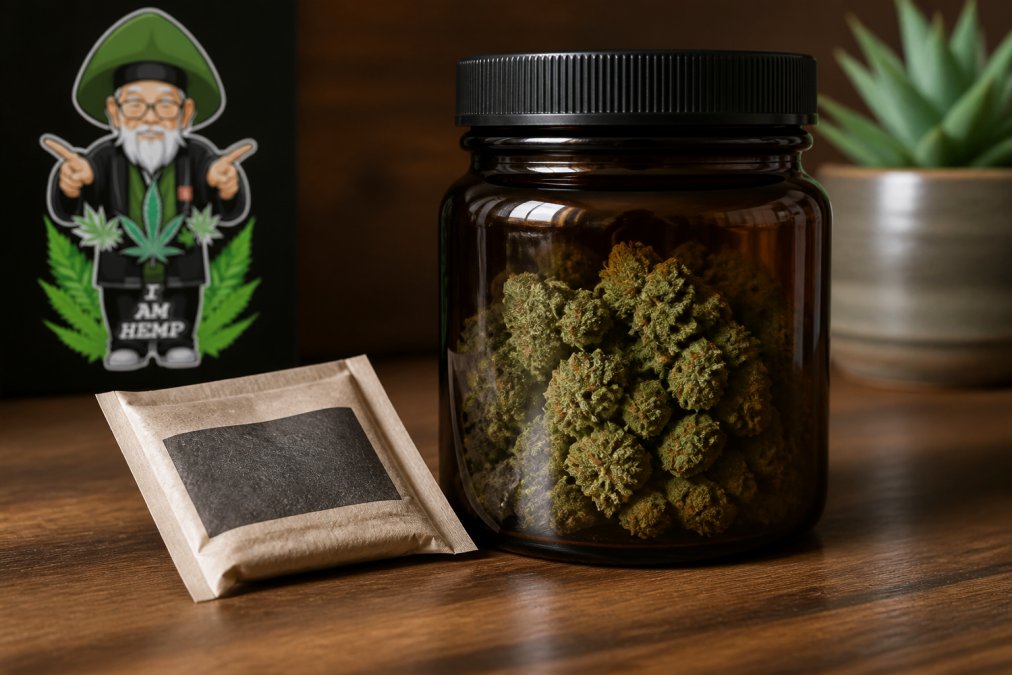
Glass vs. Plastic vs. Mylar: What Actually Protects Trichomes
Each material behaves differently over weeks and months:
| Container | Air Seal | Humidity Control | Best For |
|---|---|---|---|
| Glass jar | Excellent | Holds steady | Long-term storage |
| Plastic bag | Poor | None | Same-day use |
| Mylar pouch | Good | Moderate | Shipping, short trips |
Trichomes are the tiny resin glands carrying most of the THCa and aroma. They're fragile: static from plastic bags pulls them off, and squeezing a pouch crushes them. Glass keeps them intact because nothing touches them once the lid is on. A common mistake is reusing a jar that still smells like last month's strain, wash it, dry it fully, then load it up.
Step 2: Dial In Humidity So Your THCa Flower Shelf Life Lasts
The right humidity range for THCa flower is 58% to 62%. Below that, buds dry out and turn brittle. Above it, mold becomes a real risk.
How to Use Humidity Packs for Hemp Flower
Two-way humidity packs are the easiest way to hold that range:
- Drop one pack into the jar with the flower
- Seal the lid and wait 24 hours
- Check the hygrometer reading
- Swap the pack when it turns stiff or crunchy
- Repeat for every jar and every strain
Step 3: Control Light, Heat, and Air Exposure
Three things break down THCa flower faster than anything else: light, heat, and oxygen. Beat all three and your flower stays fresh for months:
- Light: Store in a dark place. UV light degrades cannabinoids and terpenes.
- Heat: Room temperature or cooler. Never near a window, stove, or vent.
- Air: Open the jar only when you're taking flower out. Every open counts.
Step 4: Decide Where to Store THCa Flower (and Where Not To)
The best place to store THCa flower is a cool, dark, dry spot with steady temperature, a closed cabinet, closet, or drawer away from appliances. But "cool and dark" only helps if you understand what you're fighting, because the wrong location chemically converts your flower into something else.
What Actually Breaks Down THCa Flower
Four processes run the moment your flower meets the wrong conditions:
- Oxidation. Oxygen reacts with THCa and its terpenes. Over weeks, this converts some THCa into THC and then into CBN (cannabinol), a degradation product associated with a sedative, less heady effect. This is why aged flower can feel flat or "sleepy" rather than sharp.
- Hydrolysis. Excess moisture breaks down cannabinoids and terpenes at the molecular level. Combined with warmth, it also invites mold and mildew.
- Decarboxylation. Heat drives the same THCa-to-THC conversion you'd normally trigger on purpose when smoking or vaping, except here it happens slowly and unevenly, before you ever light up.
- Terpene volatilization. Terpenes are volatile aromatic compounds. They evaporate at relatively low temperatures, which is why flower left in a warm car smells loud for a day and then smells like hay.
Temperature: The Number That Matters Most
Most practitioners aim to keep flower between 60°F and 70°F (15°C to 21°C). Below that, degradation slows dramatically; above it, every additional 10°F roughly doubles the rate of the chemical reactions above, the Q10 temperature coefficient used in food science. That's why a car is the worst possible spot: a closed vehicle on a mild 75°F day can hit 120°F to 140°F within an hour, flashing off terpenes and converting THCa to THC and then CBN in hours, not weeks.
Where Not to Store It, and the Mechanism Behind Each
- The fridge. Refrigerator humidity swings every time the door opens, and food odors migrate into porous flower. Cold also makes trichomes brittle, so handling chilled buds knocks resin off.
- The freezer. Ice crystals form inside trichome heads and rupture the cell walls. Each thaw cycle makes it worse. Freezing is only defensible for long-term extracts, not cured flower.
- A windowsill. UV light degrades cannabinoids and terpenes directly. Even indirect sunlight through glass accelerates oxidation.
- A bathroom. Steam pushes humidity well above the 62% ceiling, and mold can establish in a sealed jar within days.
- A car. Heat spikes plus light exposure plus vibration equals the fastest possible way to ruin a batch.
- Near appliances. Refrigerators, ovens, routers, and gaming consoles all radiate heat. A cabinet above the fridge is a common mistake.
The Stability Principle
Pick one spot and keep it consistent. Every temperature or humidity shift makes moisture migrate in or out of the buds and trichomes flex. Steady beats clever, a boring closet that never changes beats a smart setup that swings.
Common Storage Mistakes That Kill Potency and Flavor
Most storage failures come down to a handful of repeat offenders. Fix these and you'll protect more flower than any gadget could.
THCa Flower 29.4% | Mixed Strain Exotic →
- Using a plastic bag for more than a day. Static strips trichomes and the seal is weak.
- Skipping the humidity pack. Dry flower loses smell first, then potency.
- Stuffing the jar. Tight packing crushes buds and traps moisture pockets.
- Mixing strains in one jar. Aromas blend and you lose each strain's character.
- Storing near heat. Warmth speeds up the natural breakdown of THCa.
- Opening the jar daily to "check" it. Every peek lets oxygen in.
When Storage Fails: Why Your THCa Flower Didn't Hit Right
Sometimes flower was stored fine and still didn't hit as expected, the most common complaint in THCa communities. Here's a diagnostic path separating storage problems from consumption and product problems.
Step 1: Rule Out Incomplete Decarboxylation
THCa doesn't get you high on its own, it must lose a carboxyl group and become THC, which only happens with heat. If your flower wasn't heated enough, some THCa never converted and you got a weak or "nothing" experience. Decarboxylation is a time-and-temperature relationship, not an on/off switch: conversion begins around 220°F and accelerates as temperature rises, but also depends on how long the material is held there.
- Smoking applies direct flame and combustion heat well above 400°F. Conversion is fast and largely complete, though some THCa is destroyed by the flame itself.
- Vaping is where most users go wrong. A low-temp session at 320°F to 350°F produces flavorful vapor but converts only a fraction of the available THCa. If your flower is testing at 30% THCa and you vape at 330°F, you may be inhaling a fraction of the THC you expected. Bumping to 370°F to 400°F converts more, at the cost of some terpene flavor.
- Edibles require a separate decarboxylation step before infusion. Skipping it, or under-heating it, leaves most of the THCa intact and produces little to no effect.
Step 2: Check for Aged or Degraded Flower
THCa degrades over time into THC and then CBN, which is associated with a heavier, sleepier effect, the reason old flower can feel "muddy" rather than sharp.
How to spot it:
- Color shifts from bright green toward brown or tan
- Aroma fades from loud and complex to hay-like or muted
- Buds feel dry and crumbly rather than spongy
- Trichomes look amber or brown under magnification instead of milky white
Step 3: Account for Bioavailability Differences
Even with complete decarboxylation, how much THC reaches your bloodstream depends on the route:
- Inhaled (smoke or vapor) reaches the bloodstream in seconds to minutes, with peak effects in 10 to 15 minutes. Bioavailability is typically estimated in the 10% to 35% range depending on technique and lung retention.
- Oral (edibles) passes through the digestive system and liver first. Onset is 30 to 120 minutes, effects last longer, and the liver converts THC into 11-hydroxy-THC, which is often described as more intense and more body-focused. Bioavailability is lower, often in the 4% to 20% range, and highly variable between individuals.
Step 4: Consider Tolerance and Testing Reality
Daily use can raise tolerance: the same flower that hit hard a month ago can feel mild now, and that's a receptor issue, not a storage issue.
- How much THCa has degraded since that test
- How efficiently your consumption method converts THCa to THC
- How your individual tolerance or metabolism will respond
The Diagnostic Order
When flower doesn't hit right, check in this order:
- Consumption method and temperature, most common cause
- Flower age and appearance, look for amber trichomes and hay aroma
- Tolerance, take a short break and retest
- Product quality, compare against a known-good batch
- Storage conditions, only after the above are ruled out
Conclusion
Fresh THCa flower comes down to four habits: seal it, control humidity, block light, and keep it cool. Do those and your flower holds its smell, texture, and potency for months.
Frequently Asked Questions
How long does THCa flower stay fresh if stored properly?
Stored in an airtight glass jar with a humidity pack, kept between 60-70°F and away from light, THCa flower holds peak freshness for about 3 to 6 months. After that, terpenes fade and the flower dries out, though it stays usable for up to a year. The drop-off is gradual: you'll notice muted smell and a harsher burn before potency fades noticeably. Buy in quantities you'll finish within a few months for the best experience.
Does light exposure degrade THCa flower?
Yes. UV and visible light break down cannabinoids and terpenes over time, which is why clear bags and windowsill jars are a bad idea. Light exposure speeds up thermal degradation of THCA and oxidizes the aromatic compounds that give flower its smell and flavor. Store THCa flower in opaque or amber glass, or keep it inside a closed cabinet or drawer. Even indirect sunlight through a clear jar will dull the nose within weeks.
What is the ideal humidity level for storing hemp flower?
Aim for 58-62% relative humidity inside the container. Below 55%, flower gets brittle, trichomes flake off, and the burn turns harsh. Above 65%, you risk mold and mildew, especially in warm rooms. Two-way humidity packs hold that range automatically. If you're using humidity packs for hemp, check them monthly and swap when they feel stiff or dry. A small hygrometer in the jar takes the guesswork out of it.
Can I store THCa flower in the refrigerator?
Skip the fridge. Every time you open the door, temperature swings cause condensation inside the jar, and moisture is how mold starts. Freezers are worse: trichomes turn brittle and snap off during handling. A cool, dark cabinet or closet between 60-70°F works better. If your home runs hot in summer, a wine cooler set to 65°F is a safer option than a kitchen fridge.
