

Buy Premium Hemp Edibles Online: A 2026 Guide
Table of Contents
- Why Buying Premium Hemp Edibles Online Beats Local Options
- How to Verify Hemp Lab Reports Before You Buy
- THCa vs Delta-9 Potency: What the Numbers Really Mean
- Dosage Guide: Milligrams, Onset Time, and Your Tolerance
- State-by-State Legality and Shipping Restrictions for Hemp Edibles
- Ingredients, Dietary Needs, and Full-Spectrum vs Isolate
- Common Mistakes When You Buy Premium Hemp Edibles Online
- Conclusion: Choosing Quality Over Hype
- Frequently Asked Questions
Last Updated: October 4, 2026
Why Buying Premium Hemp Edibles Online Beats Local Options
The biggest advantage of buying premium hemp edibles online is selection and verification: you can read a full Certificate of Analysis before you spend a dollar, which almost never happens at a counter.
This guide from I AM HEMP walks through how to verify lab reports, how THCa and delta-9 potency actually differ, how to dose, and which state rules affect shipping.
FDA guidance on cannabis and cannabis-derived products
Local shops have one real edge: you walk out with the product today. Everything else favors online buying.
| Factor | Online Retailers | Local Shops |
|---|---|---|
| Lab reports available pre-purchase | Usually yes | Rarely posted |
| Product variety | Broad | Limited shelf space |
| Discreet delivery | Standard | In-person pickup |
| Price transparency | Listed upfront | Often unlisted |
| State compliance screening | Built into checkout | Varies |
How to Verify Hemp Lab Reports Before You Buy
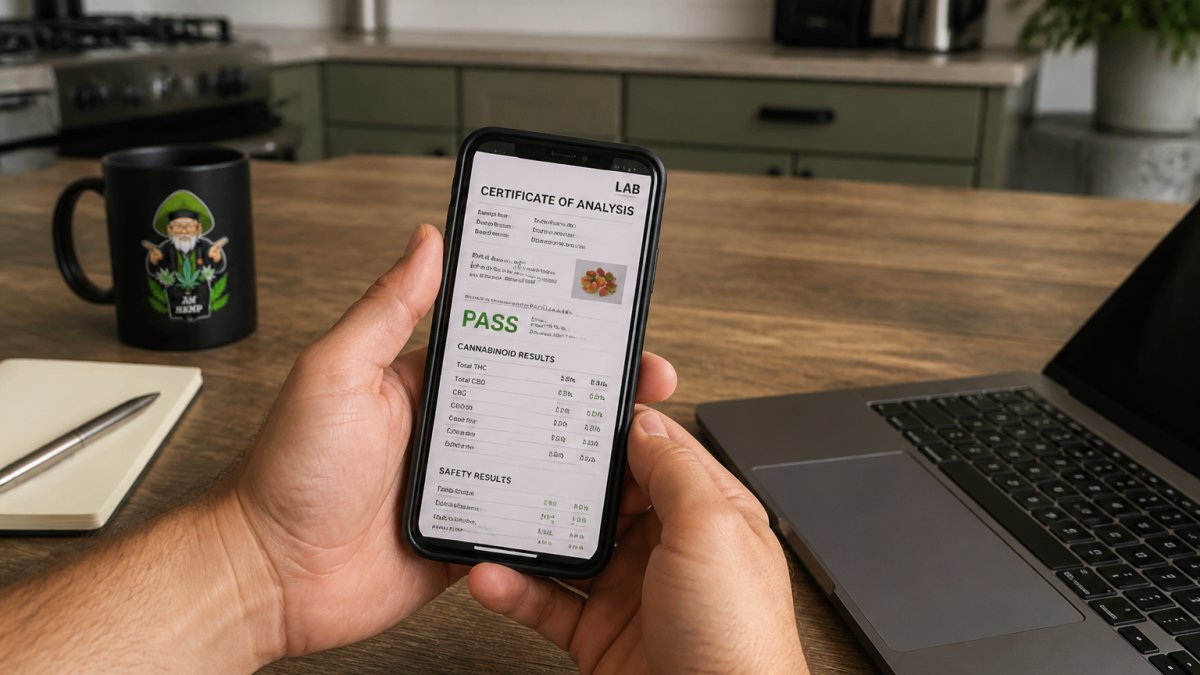
Verification starts with one question: does the COA match the batch you're buying? A Certificate of Analysis is a lab-issued document showing what a specific batch actually contains, including cannabinoid potency and contaminant screening.
What a Certificate of Analysis Actually Confirms
A COA confirms three things: cannabinoid content by dry weight, the absence of heavy metals, pesticides and residual solvents, and that the batch number matches your package. Many buyers skip the last check.
Here's how to verify a report in under five minutes:
- Confirm the batch or lot number matches your product exactly
- Check the test date (recent batches only)
- Verify the lab name is a real, independent third party
If a seller can't produce a batch-specific report, walk away. That's not caution, it's basic diligence.
THCa vs Delta-9 Potency: What the Numbers Really Mean
THCa and delta-9 THC are not the same compound, and the label numbers don't compare directly. THCa is the acidic precursor found in raw hemp; it converts to delta-9 THC when heated.
So a "20% THCa" flower and a "20% delta-9" edible are describing completely different things. THCa potency reflects what's in the raw material. Delta-9 potency reflects what's already active.
Why Nano-Emulsified Delta-9 Hits Differently
Nano-emulsified delta-9 disperses into water far more efficiently than oil-based THC, which means faster absorption and a stronger perceived effect per milligram. The molecule isn't stronger. The delivery is better. Products like I AM HEMP's Water Soluble D9 Drink Mix 20% use this approach, so a smaller serving can feel more potent than the same milligram count in a traditional gummy.

Dosage Guide: Milligrams, Onset Time, and Your Tolerance
Start low and wait longer than you think you need to. That's the entire dosing guide in one sentence. Most bad edible experiences trace back to redosing too early, not to taking too much the first time.
Onset depends on delivery format. Traditional oil-based edibles can take one to two hours to peak. Nano-emulsified and water-soluble formats often begin working noticeably faster, sometimes within 30 minutes.
| Experience Level | Starting Dose | Wait Before Redosing |
|---|---|---|
| First time | 2.5-5 mg | 2 hours |
| Occasional | 5-10 mg | 90 minutes |
| Regular | 10-25 mg | 60-90 minutes |
| High tolerance | 25 mg+ | 60 minutes |
State-by-State Legality and Shipping Restrictions for Hemp Edibles
Federal law and state law are two different questions, and a product can be federally compliant while still being restricted where you live. The 2018 Farm Bill removed hemp, defined as cannabis with no more than 0.3% delta-9 THC on a dry weight basis, from the Controlled Substances Act, which is why hemp-derived edibles can be sold and shipped across state lines at all. 2018 Farm Bill agricultural hemp provisions But that federal floor does not stop individual states from layering their own limits on top, and many have.
The Three Types of State Restrictions You'll Actually Hit
Most state-level rules fall into one of three buckets, and knowing which bucket your state is in tells you whether your order will clear checkout.
1. Total bans on hemp-derived intoxicants. A handful of states have passed laws prohibiting the sale of hemp-derived THC products altogether, regardless of the federal 0.3% threshold.
2. Cannabinoid-specific limits. Other states allow hemp edibles but cap specific compounds. Common patterns include:
- Delta-9 per-serving caps, some states limit total delta-9 THC per package or per serving to a milligram figure well below what a high-potency edible contains.
- THCa restrictions, because THCa converts to delta-9 when heated, several states treat THCa products as intoxicating and regulate or ban them separately from delta-9.
- Total THC definitions, some states calculate 'total THC' as delta-9 plus a conversion factor for THCa, which can push a product over the legal line even when the label's delta-9 number looks fine.
3. No additional restrictions. States that have not passed their own hemp-intoxicant statute generally defer to the federal framework, and compliant online orders ship normally.
Why the Rules Keep Moving
State hemp legislation has been active every year since the Farm Bill passed, and the trend has been toward tighter rules on intoxicating cannabinoids rather than looser ones. That means a state that shipped freely two years ago may restrict a specific cannabinoid today. A static 'we ship to 47 states' banner on a product page is not a compliance policy, it's a snapshot that may already be stale.
Water Soluble D9 Drink Mix 20% →
How Reputable Sellers Screen Orders
The compliance signal to look for is screening at checkout, not a blanket claim. A seller with real compliance infrastructure typically:
- Collects your shipping address before finalizing payment and blocks restricted destinations automatically
- Flags specific SKUs as non-shippable to specific states rather than applying one rule to the whole catalog
- Updates restrictions as state laws change and notes the last-updated date on its shipping policy
If a site will ship any product to any address with no state screening, treat that as a red flag about the rest of their operation. A seller cutting corners on compliance is often cutting corners on lab testing too.
What to Do Before You Order
- Confirm your state has not banned hemp-derived intoxicants.
- Check whether your state caps delta-9 per serving or regulates THCa separately.
- Read the seller's shipping policy for a last-updated date, not just a state count.
- If your order is blocked at checkout, assume the block is correct, do not ask a seller to route around it.
State rules are the single most common reason a legitimate order fails, and they are the reason 'federally legal' and 'shippable to me' are not the same sentence.
Ingredients, Dietary Needs, and Full-Spectrum vs Isolate
Read the ingredient panel the same way you'd read any food label, then read it a second time for the cannabinoid blend. The two halves of the label answer different questions: the food ingredients tell you what you're eating, and the cannabinoid profile tells you how the product is likely to feel.
Full-Spectrum, Broad-Spectrum, and Isolate: What the Words Mean
Full-spectrum products retain the plant's full range of cannabinoids and terpenes, including trace amounts of THC. Broad-spectrum starts from the same extract but removes the THC, keeping most other cannabinoids and terpenes. Isolate is a single purified cannabinoid, usually CBD, with everything else stripped out.
Full-spectrum is not automatically better. It depends on what you want. If you are avoiding any trace of THC, broad-spectrum or isolate is the cleaner choice. If you want the fuller plant profile, full-spectrum is the point.
The Entourage Effect: Why Blends Matter More Than Single Cannabinoids
The reason full-spectrum products are formulated the way they are comes down to what researchers call the entourage effect, the idea that cannabinoids and terpenes interact with each other and with the body's endocannabinoid system in ways a single isolated compound does not replicate. The mechanism is not fully settled science, but the pattern shows up consistently in how formulators build products, and it is the reason two edibles with identical total milligram counts can feel different.
A few pairings worth understanding:
- THC + CBD. CBD is widely believed to soften the edge of THC, many users report less anxiety and a less sharp peak when the two are combined, even at the same THC dose. This is the most common blend in balanced edibles.
- THC + CBN. CBN is a minor cannabinoid most often associated with relaxation and sleep-focused formulas. Products marketed for nighttime use frequently pair a modest THC dose with CBN rather than pushing THC higher.
- THC + CBG. CBG is often described as more energizing or focus-oriented in user reports, and it shows up in daytime formulas paired with lower THC.
The label tells you what is in the product. The COA tells you whether the label is true. The cannabinoid blend tells you what the product is trying to do. Read all three.
Dietary and Ingredient Considerations
For dietary needs, look for organic and vegan labels where they matter to you, and check the base, gummies are typically pectin-based (vegan) or gelatin-based (not vegan), and the difference is easy to miss. Melatonin-infused options exist for sleep-focused users, but check the milligram amount carefully, since melatonin and cannabinoids affect people differently and stacking them can overshoot.
How to Read a Cannabinoid Blend Label
- Find the total milligrams per serving, not per package.
- Note the ratio, a 1:1 THC:CBD product behaves differently from a 10:1.
- Check whether the blend includes minor cannabinoids like CBN or CBG, and at what milligram amount.
- Cross-reference the blend against the COA to confirm the numbers are real.
- Match the blend to your goal, daytime focus, evening relaxation, or sleep, rather than buying on total potency alone.
Common Mistakes When You Buy Premium Hemp Edibles Online
The most expensive mistake is trusting a potency claim with no lab report behind it. Here's what we see buyers get wrong most often:
- Buying on price alone and skipping verification entirely
- Assuming a "high-potency" label means a tested potency
- Ignoring state shipping restrictions until checkout fails
- Comparing THCa numbers directly to delta-9 numbers
A common mistake is treating every seller's "lab tested" claim as equal. It isn't. Some post generic reports that don't match any specific batch. Others publish batch-specific COAs you can verify in minutes. That difference is the whole game.
Conclusion: Choosing Quality Over Hype
The hemp edibles market rewards buyers who verify and punishes those who don't. Check the COA, match the batch, understand your dose, and confirm your state allows the shipment before you order.
At I AM HEMP, every batch is lab-tested with COAs you can review, sourced from trusted American farms, and shipped in discreet, inconspicuous packaging.
Get started with I AM HEMP and buy premium hemp edibles online with the verification standards you deserve.
Frequently Asked Questions
Can I legally order hemp edibles online in 2026?
Yes, if the edibles are derived from industrial hemp and contain no more than 0.3% Delta-9 THC by dry weight, they are federally legal under the 2018 Farm Bill. However, some states have stricter rules. Always check your state's regulations before ordering, and buy from retailers that clearly label THC content and provide lab reports.
How do I verify the lab results of hemp edibles?
Look for a Certificate of Analysis (COA) from an ISO-accredited third-party lab. The COA should list cannabinoid potency, heavy metals, pesticides, residual solvents, and microbials. Reputable sellers like I AM HEMP publish COAs for each batch. If a company won't show you a COA before purchase, walk away.
What is the difference between THCa and Delta-9 edibles?
THCa is the raw, non-psychoactive precursor found in hemp flower. When heated, it converts to Delta-9 THC, which is psychoactive. Edibles labeled as Delta-9 contain already-activated THC. Potency varies: a 10mg Delta-9 edible may feel stronger than a THCa product because THCa requires decarboxylation to take effect. Always check the label for total THC.
Are there safety standards for buying hemp edibles online?
The FDA does not regulate hemp edibles as dietary supplements, so safety depends on the seller. Choose companies that use third-party lab testing, provide batch-specific COAs, and follow good manufacturing practices. Avoid products with vague labels or no lab data. I AM HEMP, for example, tests every batch for potency and contaminants.
