

7 Ways to Verify Hemp Lab Results: 2026 Guide
Table of Contents
- Why Verifying Hemp Lab Results Matters Before You Buy
- How to Read a COA: Matching Batch Numbers and Sample IDs
- 1. Scan the QR Code and Cross-Reference the Lab Portal
- 2. Confirm the Testing Lab Is Independent and Licensed
- 3. Check for ISO 17025 Accredited Labs and Accreditation Numbers
- 4. Review the Full-Panel Test: Pesticides, Heavy Metals, and More
- 5. Read the Cannabinoid and Terpene Profile on a Dry-Weight Basis
- 6. Hemp Lab Test Red Flags: Doctored PDFs and Missing Data
- Frequently Asked Questions
Last Updated: September 28, 2026
Why Verifying Hemp Lab Results Matters Before You Buy
Learning how to verify hemp lab results means confirming the batch in your hand matches the numbers on the page, the lab is legitimate, and nothing important was left out. At I AM HEMP, every batch we ship carries a Certificate of Analysis, and we expect customers to check it. This guide covers seven verification methods, from QR code scans to spotting a doctored PDF.
How to Read a COA: Matching Batch Numbers and Sample IDs
The first check is the one most buyers skip: does the batch number on your product label match the batch number on the COA? If not, the report describes a different batch than the one in your hand.
- Check the batch number on the label against the batch number on the report
- Confirm the sample ID is present and unique, not a generic placeholder
- Look for a harvest or production date that makes sense for the product
- Verify the product name and weight on the COA match what you ordered
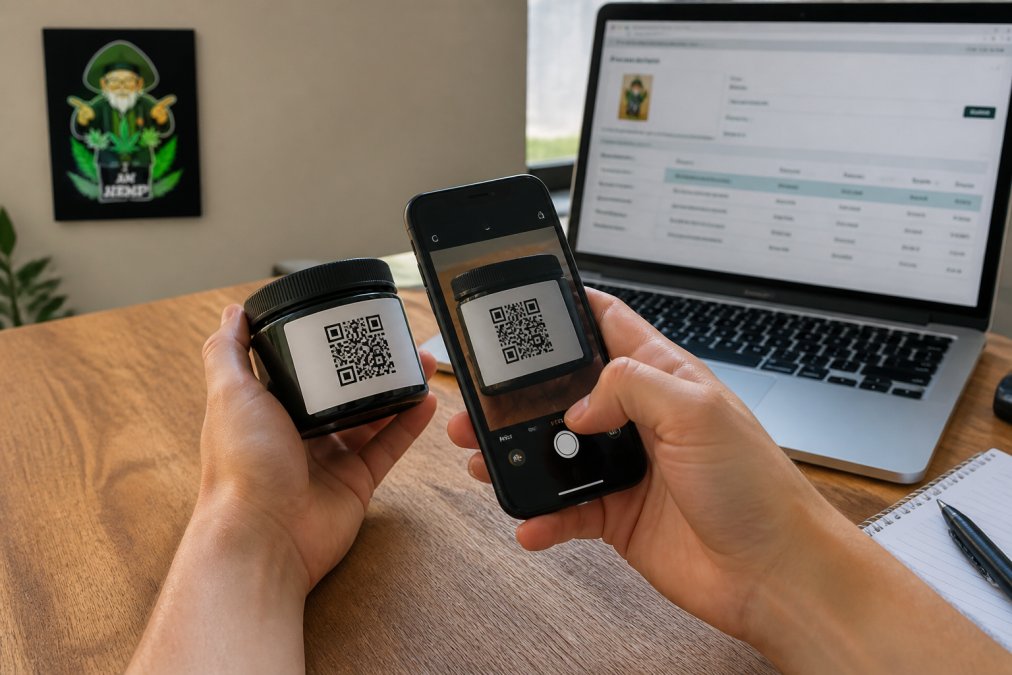
1. Scan the QR Code and Cross-Reference the Lab Portal
A QR code on the label should land on a real lab report, not a marketing page or a generic PDF.
2. Confirm the Testing Lab Is Independent and Licensed
Third-party testing only means something if the lab has no financial stake in the result. An in-house lab run by the seller is not independent testing, however it is labeled.
- Search the lab name plus "license" or "certification" to confirm it exists
- Check whether the lab appears on your state's approved testing facility list
- Look for a physical address and contact information, not just a logo
- Be cautious if the same lab name appears only on the seller's own materials
3. Check for ISO 17025 Accredited Labs and Accreditation Numbers
ISO 17025 accreditation is an international standard confirming a testing laboratory has demonstrated competence in its specific testing methods. It is granted by an independent body and comes with a certificate number you can verify.
4. Review the Full-Panel Test: Pesticides, Heavy Metals, and More
A potency-only COA tells you how much cannabinoid is in the product, not what else is in there. Full-panel testing covers the safety categories, and what the numbers must be for a pass.
A complete panel typically includes:
- Pesticide screening for agricultural chemicals used during cultivation
- Heavy metals testing for lead, arsenic, cadmium, and mercury
- Microbial analysis for mold, yeast, and bacteria
- Mycotoxins testing for mold-derived toxins
- Residual solvents for extracts made with chemical extraction methods
- Potency testing for cannabinoid content
What 'Pass' Actually Means: Action Limits, Not Zero
The most misunderstood part of a COA is the difference between "not detected," "below the limit of quantification," and "pass." A report that blurs them is hiding information.
-
Not detected (ND) means the instrument found nothing above its detection threshold. This is the strongest result.
-
Below the limit of quantification (LOQ) means something may be present, but at a concentration too low for the lab to measure reliably. This is common and usually acceptable.
-
Pass means the measured value is at or below the regulatory action limit for that contaminant, it does not mean the contaminant is absent.
-
Lead: often capped in the low single-digit ppm range
-
Arsenic, cadmium, mercury: typically capped below lead, in the fractional-to-low ppm range
-
Residual solvents (e.g., butane, hexane, ethanol): limits vary widely by solvent class, with Class 1 solvents held to the tightest thresholds
-
Mycotoxins (aflatoxins, ochratoxin A): usually capped in the low parts-per-billion range
Reading the Reporting Limit
The reporting limit (also called the limit of detection or LOQ) tells you how sensitive the test was. A pesticide screen with a 0.5 ppm reporting limit cannot catch a contaminant at 0.1 ppm, so two labs can both report "pass" on the same sample at very different sensitivities. Unusually high reporting limits mean a weaker pass than it looks.
Match the Panel to the Product
For solventless products like hash and bubble hash, residual solvents testing is less critical because no solvent was used. For distillates and other solvent-extracted concentrates, it matters a great deal. Match the panel to how the product was made, a distillate COA with no residual solvents row is incomplete, not clean.
5. Read the Cannabinoid and Terpene Profile on a Dry-Weight Basis
Potency numbers mean little without knowing their basis. Dry-weight basis means the percentage reflects the cannabinoid content of the dried plant material, the standard most labs use. If a COA does not state its basis, ask.
6. Hemp Lab Test Red Flags: Doctored PDFs and Missing Data
A PDF can be edited. The most common alterations are simple: changing a potency number, deleting a failing contaminant row, or swapping the batch number. What separates a real report from a convincing fake is usually the small visual and structural inconsistencies editing leaves behind. Here is how to inspect a digital COA the way a document examiner would.
Start With the Text Layer, Not the Image
Most doctored COAs are edited as images or flattened PDFs, so the text is no longer selectable. Open the PDF and try to highlight a number in the results table.
- If you can select and copy the text, the report was likely generated as a native digital document, a good sign, though not proof.
- If you cannot select anything, the page may be a scan or an image export. That is not automatically fraudulent, but it removes your ability to check the text layer and is worth noting.
- If some rows are selectable and others are not, that inconsistency is a strong signal that part of the document was pasted in or replaced.
Font and Kerning Inconsistencies
When someone edits a number in a PDF, the replacement rarely matches the original font exactly. Look closely at the results table:
- Weight and stroke width: a digit that looks slightly bolder or thinner than its neighbors
- Kerning: uneven spacing between characters in one cell versus the rest of the row
- Baseline drift: a number that sits a pixel or two higher or lower than the others in its column
- Color mismatch: a number that is a slightly different shade of black or gray than the surrounding text
- Font substitution: a serif digit in a table of sans-serif numbers, or a different numeral style (e.g., an open-top 4 next to closed-top 4s)
Row Alignment and Table Geometry
Tables in legitimate reports are software-generated, so rows and columns line up precisely. Edited tables often do not:
- A row that is slightly taller or shorter than the others
- A cell border that is missing, doubled, or offset by a pixel
- A value that does not sit on the same baseline as the rest of its row
- A deleted row that leaves a gap in the row numbering or a mismatched total
Check the PDF Metadata
Most PDF readers let you view document properties under File > Properties, or by right-clicking the document. Look at:
- Creation date and modified date: if the modified date is later than the creation date, the file was edited after it was generated
- Authoring application: a report generated by a lab's LIMS system will usually show that system or a standard PDF producer. A file showing an image editor or a generic office suite as the producer is a red flag
- Producer and author fields: blank or mismatched fields are worth questioning
Signature, Seal, and Page Integrity
- A report that ends abruptly without a lab signature, stamp, or authorized-signer name
- Missing page numbers, or a page count that does not match the document
- A lab logo that is low-resolution, stretched, or does not match the lab's real branding on its own website
- A report with no lab contact information, address, or accreditation number
The Reuse Pattern
One of the most common frauds is not editing at all, it is reuse. A single passing COA gets attached to multiple unrelated products or batches. Cross-check the batch number and sample ID against other listings from the same seller; if the same report appears under different products, it does not belong to the product in your hand.
The Check That Beats All Others
The most reliable verification is the one covered earlier: confirm the sample ID exists in the lab's own portal. A doctored PDF cannot create a matching record in a lab's system. Visual forensics help you spot a fake, but the portal check is what confirms a real one.
Frequently Asked Questions
What is a Certificate of Analysis (COA) for hemp?
A COA is a document from an independent laboratory that reports the test results for a specific batch of hemp. It lists the cannabinoid profile, including THC concentration, plus results for pesticides, heavy metals, residual solvents, microbials, and mycotoxins. A valid COA includes the batch number, sample ID, lab name, accreditation number, and testing date. Always match the batch number on the COA to the one printed on your product.
How can you tell if a hemp lab report is fake?
Look for red flags: missing batch numbers, no lab name or license, inconsistent fonts, low-resolution logos, and results that are suspiciously perfect. Open the PDF and check the metadata; a doctored file often shows a different creation date or editing software. Cross-reference the sample ID on the lab's own portal. If the lab cannot confirm the sample, treat the report as unverified.
Are third-party lab tests required for hemp products?
There is no single federal mandate that every hemp product carry a COA, but most state-licensed programs and reputable sellers require third-party testing. The 2018 Farm Bill legalized hemp at 0.3% THC on a dry-weight basis, and testing is how that threshold is verified. Buyers should treat a missing COA as a sign the product has not been independently checked for potency or contaminants.
What should I look for on a hemp lab test?
Check five things: the batch number and sample ID match your product; the lab is ISO 17025 accredited with a verifiable accreditation number; the panel covers cannabinoids, pesticides, heavy metals, residual solvents, microbials, and mycotoxins; THC is reported on a dry-weight basis; and the report is dated within the last 12 months. If any of these are missing, ask the seller for a complete COA before buying.
What are the common red flags in a hemp COA?
Common red flags include no lab license number, no accreditation, missing sample ID, results that only show total THC without a full panel, and PDFs that cannot be verified on the lab's website. Watch for COAs that list a different product name than what you bought, or that use vague terms like 'passed' without numeric limits. A trustworthy COA shows actual numbers against known contaminant thresholds.
