

Are THCa Concentrates Worth It for Daily Use?
Table of Contents
- What Daily THCa Concentrate Use Actually Delivers
- THCa vs. THC: What Changes When You Heat a Concentrate
- How to Dose THCa Concentrates Without Overdoing It
- THCa Concentrate Tolerance Buildup and What It Costs You
- Drug Testing: The Daily-Use Question Most Guides Skip
- Long-Term Daily Use vs. Acute Relief: What the Difference Means for You
- Shop High Quality Hemp Vapes 2026: What to Check Before You Buy
- Frequently Asked Questions
Last Updated: September 28, 2026
What Daily THCa Concentrate Use Actually Delivers
Daily THCa concentrate use delivers fast-acting, potent effects comparable to traditional cannabis concentrates, because THCa converts to THC when heated. At I AM HEMP, experienced hemp users ask us constantly: is a daily dab habit sustainable, or does it quietly stop working? The answer depends on three variables most guides ignore: your dose, your format, and how your body builds tolerance.
THCa vs. THC: What Changes When You Heat a Concentrate
Heating a THCa concentrate converts tetrahydrocannabinolic acid into delta-9 THC through decarboxylation, the same reaction that happens when you light flower. The raw extract is not psychoactive in its acid form; apply heat and the pharmacology shifts entirely.
How to Dose THCa Concentrates Without Overdoing It
Start with a single rice-grain-sized amount, roughly 5 to 10 milligrams of THC equivalent, and wait a full 15 minutes before considering more. Titration is the most important skill for daily concentrate users, and the one most people skip.
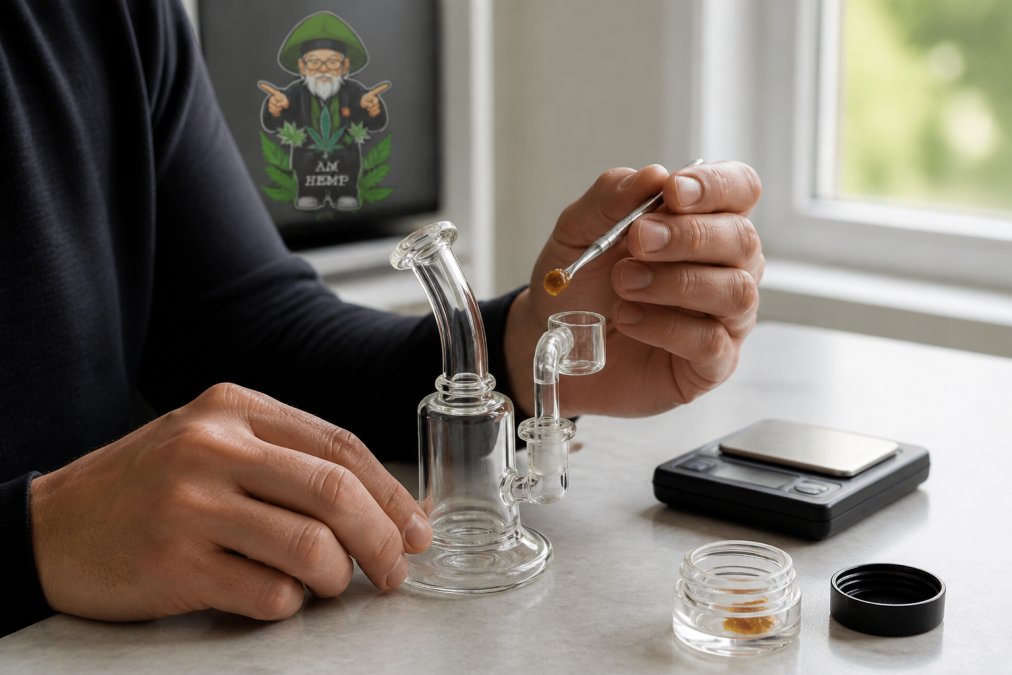
Starting Dose by Format: Diamonds, Live Resin, Distillate, Crumble
| Format | Typical Potency | Starting Dose | Best For |
|---|---|---|---|
| THCa Diamonds | 87% | 5 mg THC equivalent | Experienced users, fast onset |
| Live Resin | 94.1% | 5 mg THC equivalent | Flavor chasers, full-spectrum effects |
| Distillate | 99.09% | 3-5 mg THC equivalent | Precise dosing, custom infusions |
| Crumble | 67.6% | 5-10 mg THC equivalent | Bowl toppers, joint enhancement |
THCa Concentrate Tolerance Buildup and What It Costs You
THCa concentrate tolerance buildup happens faster than with flower because concentrates deliver far more THC per session, and CB1 receptors downregulate in response. That downregulation is your endocannabinoid system maintaining homeostasis, the same dab that worked last month may barely register now.
What Tolerance Actually Costs, in Numbers
A daily user who starts at 5 mg THC equivalent per session and drifts to 15 mg is not unusual. That 3x increase means a 1-gram jar of live resin at 94.1% THC (roughly 941 mg) that lasted 30 sessions at 5 mg now lasts 10 sessions at 15 mg, the cost per session triples even if the jar price does not move.

A Taper Protocol That Works Better Than Cold Turkey
Going from 15 mg to zero overnight is the fastest route to a bad week. A gentler taper:
- Days 1-2: Cut each session dose by 25% (15 mg to roughly 11 mg).
- Days 3-4: Cut again to 50% of your original dose (roughly 7-8 mg).
- Days 5-7: Drop to a single small session per day, or switch to flower at low THC for the same ritual without the concentrate load.
- Days 8-14: Full break, or a low-dose maintenance session every other day.
The Long-Term vs. Acute Distinction
Most guides blur two different goals. Acute relief means using a concentrate occasionally, when a specific need arises, and returning to baseline, tolerance barely enters the picture. Long-term daily use means a steady routine, and the receptor math above is unavoidable. Neither is inherently wrong; the mistake is using a daily habit to chase an acute-relief outcome. If you need a concentrate every day just to feel normal, that is a tolerance signal, not a therapeutic win.
Drug Testing: The Daily-Use Question Most Guides Skip
Daily THCa concentrate use will almost certainly trigger a positive result on a standard THC drug screen, because heating converts THCa to THC and THC metabolites accumulate with repeated use. Most guides avoid this question; it deserves a direct answer.
What the Test Is Actually Looking For
Standard workplace urine immunoassays screen for the carboxy metabolite 11-nor-9-carboxy-THC (THC-COOH), not for THC itself or the acid form THCa. The test does not care whether you consumed flower, a vape, an edible, or a THCa diamond, only whether your body has processed THC into that metabolite and stored it in fat tissue. Because THC-COOH is lipophilic, it clears slowly, and daily exposure keeps refilling the reservoir.
Detection Windows Scale With Dose and Frequency
Detection windows are not a fixed number, they scale with how much THC you have been taking and how often. A commonly cited framework from workplace testing literature:
- Single use, low dose: roughly 1-3 days
- Occasional use (a few times per week): roughly 3-7 days
- Regular use (several times per week): roughly 10-21 days
- Heavy daily concentrate use: weeks to over a month, with some chronic users testing positive beyond 30 days
The Legal-Hemp Trap
This is the part that catches people off guard. THCa products sold as hemp are federally legal under the 2018 Farm Bill framework when they contain no more than 0.3% delta-9 THC by dry weight, but that legal status has nothing to do with what shows up on a drug screen. The FDA's guidance on cannabis and cannabis-derived products makes clear that legality of a product and detectability of its metabolites are separate questions.
What This Means for Anxiety-Prone Daily Users
If you use THCa concentrates to manage anxiety, the drug-testing question is not abstract, it can cost you a job, a scholarship, or a legal position. Anyone subject to workplace, athletic, or legal testing should treat daily THCa concentrate use as incompatible with passing a THC screen. If testing is a factor in your life, that reality should drive your decision before potency or flavor enters the conversation.
Practical Decision Framework
- No testing exposure: daily use is a tolerance and cost question, not a detection question.
- Occasional testing (pre-employment, annual): a 30-day abstinence window before a known test is the only reliable approach for daily concentrate users.
- Random or continuous testing: daily THCa concentrate use is functionally incompatible with the program. Occasional, low-dose flower use is a lower-risk alternative, but not a zero-risk one.
- Athletic or legal testing: treat any THC metabolite exposure as disqualifying and consult the specific program's rules, which often have lower thresholds than workplace screens.
The honest summary: if passing a THC screen matters to you, daily THCa concentrate use is the wrong format. If it does not, this section is not a reason to avoid concentrates, but it is a reason to know exactly what you are choosing.
Long-Term Daily Use vs. Acute Relief: What the Difference Means for You
Long-term daily use and acute relief are different goals calling for different strategies. Acute relief means occasional use when a specific need arises, returning to baseline afterward. Long-term daily use means a steady routine, bringing tolerance, cost, and cognitive considerations occasional users never face.
Shop High Quality Hemp Vapes 2026: What to Check Before You Buy
When you shop high quality hemp vapes 2026, verify a current Certificate of Analysis (COA) from an accredited third-party lab, not a marketing claim. Potency numbers mean nothing without independent verification of cannabinoid content, residual solvents, heavy metals, and pesticides.
-
Batch-specific COAs you can actually open, not a generic PDF reused across products
-
Potency matching the label, within normal lab variance
-
Full contaminant panel, including solvents, metals, pesticides, and microbials
-
Clear sourcing, ideally from domestic farms with traceable cultivation
-
Discreet, protective packaging so product arrives intact and private
-
THCa Diamonds | 87% at $9.00 for precise, fast-onset dabs

THCa Diamonds | 87% -
1 Gram THCa Live Resin | 94.1% at $14.99 for full-spectrum flavor and effects
-
THCa Distillate | 99.09% at $29.99 for maximum purity and custom infusions

THCa Distillate | 99.09% -
1 Gram THCa Crumble | 67.6% at $10.00 for bowl toppers and joint enhancement
Frequently Asked Questions
Is it safe to use THCa concentrates every day?
Daily use is possible for experienced adults 21+, but the main concerns are tolerance and dose creep rather than acute danger. THCa converts to THC when heated, so daily concentrate use works like daily THC use: your CB1 receptors downregulate and each session delivers less effect. Track your dose in milligrams, take at least one full day off per week, and stop if you notice mental clarity or sleep quality slipping. Buy lab-tested product with a current COA so you know exactly what you are dosing.
How does THCa convert to THC when using concentrates?
THCa is tetrahydrocannabinolic acid, the non-psychoactive form of THC found in raw cannabis. Heat triggers decarboxylation, which removes a carboxyl group and converts THCa into Delta-9 THC. With a concentrate, that happens the moment your dab hits a hot nail or your vape coil fires. This is why THCa distillate at 99.09% hits like a high-potency THC product even though the jar label reads THCa, not THC.
How do THCa concentrates differ from THCa flower in potency?
Concentrates run far higher. THCa flower typically tests in the 20-30% range, while I AM HEMP concentrates range from 67.6% THCa Crumble to 87% THCa Diamonds and 99.09% THCa Distillate. That means one small dab can deliver the cannabinoid load of several bowls of flower. If you are moving from flower to concentrates, start with a fraction of your usual session size and wait 15 minutes before adding more.
What should I look for in lab-tested THCa concentrates?
Ask for a batch-specific certificate of analysis you can open before you buy, not a generic PDF. The COA should list THCa percentage, total cannabinoids, terpene profile, and pass results for pesticides, heavy metals, residual solvents, and microbials. I AM HEMP publishes a COA for every concentrate, including THCa Diamonds, Live Resin, Distillate, and Crumble, so you can verify potency and contaminants for the exact batch shipping to you.
Daily concentrate use is worth it only when your dose stays stable, your format matches your routine, and you understand the testing and tolerance realities before you commit. If you're ready to build a sustainable daily routine with verified, lab-tested concentrates, I AM HEMP offers handpicked indoor products, transparent COAs, and discreet fast shipping. Choose options that fit your experience level and dose with confidence.
